Breaking Through to Life. Foreword
You know them well. Those moments when you feel a connection to life. An evening in May, when you stand watching three swallows playing in the glowing sky. A night in a hospital, where someone you loved has now taken their last breath, and something loosens, allowing the grief to flow freely. A Tuesday morning with the usual bit of stress in the kitchen, where you suddenly realise, amidst the chaos, that everything is alright.
What do these moments have in common? That there were no distractions. No resistance. No confusion. No mental fog. What else do they have in common? That they did not arise as a result of an effort, but rather because something within you let go. The grinding thoughts, the inner turmoil – the eternal urge for something to be different. The mind briefly settled into a natural clarity. And for as long as that moment lasted, everything was exactly as it should be. Mind you, regardless of whether what happened was good or bad or somewhere in between. For peace of mind and a zest for life do not depend on external circumstances. They depend on how you face what is happening.
Imagine if you could have more moments like that. Yes, imagine if you could connect with life all the time. Imagine if you could face whatever happened with serenity, clarity and unconditional kindness. And with skillful decisiveness when that was what was needed.
Spoiler alert: You can. And it’s not something I’ve made up. I got it from an ancient Indian sage.
*
The sage’s name was Siddhattha Gotama, and he lived in north-eastern India 2,500 years ago. We know him by his title, Buddha, which means ‘the Awakened One’. You might be thinking: What can an Indian sage from the Iron Age teach us about the good life today?
I would have been the first to ask that sceptical question myself if, ten years ago, someone had mentioned anything about Buddhism. For I was not, and still am not, a religious person. I was, and still am, a rational person with a scientifically grounded understanding of reality. And I was rather impatient back then. So I would probably have cut the presumptuous person off before he or she had even begun to talk about Buddhism. About how a combination of wisdom, morality and meditation can lead to a life with greater clarity, greater kindness and greater mental stability.
I had to go through a long-lasting life crisis before I—slowly and reluctantly—realised that the old Indian sage was onto something. At the age of 49, I had hit a dead end. Major problems in my close relationships. A working life that was falling apart. A bit too much use of intoxicants. Relentless self-criticism. And a stubborn belief that the only thing to do was to plough my way through the mire. But I wasn’t getting anywhere.
Now, almost ten years later, I am, to put it mildly, in a different place. I don’t usually throw around big words, but my life has been completely transformed. From despondency, anxiety, low self-esteem and emerging substance abuse problems to a life characterised by ease, vitality and peace of mind. Joy in close relationships, joy in working life, no interest in drugs. The change is all-encompassing – almost a miracle. But only almost. For it is not due to divine intervention. It is the result of some concrete and actually quite logical changes in how I perceive the world and perceive my own thoughts and feelings. These changes have come about thanks to a brilliant user manual for life. Buddha’s user manual.
That’s the one I’d like to pass on to you. But you don’t have to spend as much time changing your life as I did. If I’d been less sceptical and less slow on the uptake, it probably wouldn’t have taken quite so many years. In a sense, the Buddha’s teachings are actually quite straightforward. But I’m not promising you anything in advance. Because a user manual for life is like a baking recipe or a knitting pattern. You have to bake the cake yourself. You have to knit your life together yourself. No one else can do that for you—not even the Buddha. But let me show you what the recipe is all about. Hopefully, you’ll then be better able to decide if this is something you want to take on.
The Buddha and his teachings in a nutshell
Siddhattha Gotama grew up as the son of a prince, and legend has it that he lived a carefree and sheltered life in his father’s palace until one day he took a ride outside the city walls and witnessed human suffering for the first time. He saw old, sick, and dying people and was horrified. And so he set out to find the answer to one of life’s greatest questions: Why do we suffer? He left his father’s palace and spent several years as a voluntary homeless person and spiritual seeker. And at the age of 35, during a long night of meditation, he found the answer to his question and awoke to a completely different life—or rather, to a completely different perspective on life. Now he could see how we humans create suffering for ourselves. And he could see how we can avoid it. That night, he became the Buddha—“the one who has awakened.” He began to teach and quickly gained followers. A community of wandering monks and nuns formed around him.
Buddhism subsequently spread to large parts of Asia, and along the way it developed into three main branches, known as Theravada, Mahayana, and Vajrayana. These three quite different forms of Buddhism dominate different regions: Southeast Asia (Sri Lanka, Thailand, Myanmar), East Asia (China, Japan, Korea), and the Himalayan region (Tibet, Bhutan). In the 1800s, Buddhism began to make a serious impact on the West, and with the hippie generation and their travels to Asia, it gained a foothold in mainstream Western culture, where everyone now knows the meaning of “zen” or “mindful.” On the other hand, not many people know what the Buddha actually spoke about, and how he differs in crucial ways from figures like Moses, Jesus, and Muhammad.
The Buddha did not consider himself divine. He did not claim to be the son of a god or a spokesperson for a god, and he did not demand that his followers believe blindly in what he said. On the contrary, he often concluded his speeches by saying, “See for yourself!” or “Check it out for yourself!”—in other words, an invitation for us to empirically test whether what he says actually holds true. In that sense, Buddhism is neither religious nor particularly mystical, but practical: There is nothing you have to believe in—instead, there is something you can do.
The Buddha’s recipe for the good life is traditionally called “the Noble Eightfold Path.” I prefer the term “the Wise Eightfold Path”—among friends, it’s called the Wise Path, or simply the Path.
The path winds its way through all aspects of life: our love lives and work lives, the social and political life we share in community, and the inner life each of us lives with worries and fantasies, confusion and clarity. The Path offers you a way through it all. It is not so much a theory or a philosophy as it is a method. A set of skills you can practice—and use in all kinds of contexts. In fact, a systematic training program to gain more clarity in life.
The Path consists of eight factors. At first glance, it may seem both complicated and abstract—like a knitting pattern if you’ve never knitted before. But don’t worry: as soon as you start knitting, it becomes more manageable and very concrete.
Here are the eight steps:
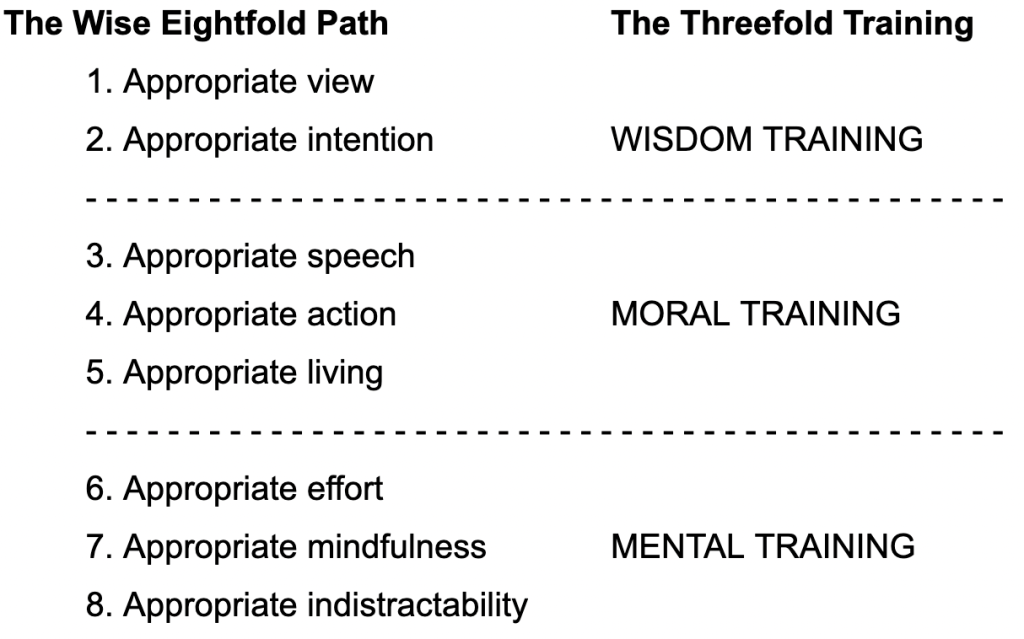
The word “appropriate” should not be understood as “decent.” It is not a moral but a practical concept and should be understood as “well-chosen”—in the same way that a particular tool can be well-chosen for a specific task. If you want to drive a nail, a hammer is an appropriate tool. The Wise Eightfold Path is intended to lead to an easier life. So an appropriate view is one that frees you and others from unnecessary trouble. That it is appropriate does not mean it is “nice” or “correct,” but rather that it is a liberating view. The same applies to the other seven points.
As you can see, the eight factors fall into three categories. In a simplified version, the path is therefore described as the threefold training: wisdom training, moral training, and mental training, which is what we today call meditation. Here is a short version of the Wise Eightfold Path:
To begin with, you need to have a realistic view of reality so that you can see the situation clearly. Only then can you set a direction, that is, form an intention to guide you. The Buddha generally recommends renunciation, goodwill and non-violence as guiding principles.
When you know what you fundamentally want, it becomes easier to use appropriate speech, even in tense situations, without saying anything you will regret afterwards. You also find it easier to avoid harming others or yourself when you take action. Indeed, overall, it will lead to a more mature and responsible living.
Your moral conduct thus grows out of your wisdom. Not out of a regime of rules to which you submit – voluntarily or under duress. Mental training, on the other hand, is necessary to put both wisdom and morality into practice, so that Buddhism is not just something you adorn yourself with in your head or preach to others.
Without the necessary mental effort, none of this will happen. Without loving mindfulness, you will forget all that is important and all that is right, even though you know full well what these things are. And without a strong inner indistractability, your mind is completely at the mercy of external circumstances and can only find peace if reality bends to your will. As we know, it does not always do so.
The eight factors are sort of focal points, pointing to the places in life where we can get stuck. Note that if we slip up on just one step, we risk falling over all other steps too. So …
if we misunderstand a situation,
if we are driven by the wrong intentions,
if we do not communicate clearly,
if we act destructively,
if we organise our lives without consideration for others,
if we overwork or underwork ourselves,
if we become distracted and confused, or
if we cannot keep a steady hand on the wheel
… well, then this will often affect some of the other steps. Or be caused by some of the other steps.
A strange kind of path, when you think about it. For on closer inspection, the eight points are not steps on a path. Not stages to be covered in numerical order, not rungs on a ladder. All the rungs of the ladder seem to be in play at the same time. The path – and the ladder – seem somewhat muddled. That is because, in reality, it is a wheel.
I suppose I’d better explain that.
Take control of your life, calm your nerves, and see things more clearly
When a Buddhist user manual is traditionally structured as if the eight parts of the training were eight steps along a path, where one step leads to the next, it is primarily for pedagogical reasons. Since, unfortunately, you cannot say it all at once, you have to start somewhere. But in the real world, the eight factors are interlinked and reinforce one another in all directions.
You will see this time and again throughout the book, where I point out that you cannot have appropriate speech without appropriate mindfulness, no appropriate mindfulness without appropriate living, no appropriate living without appropriate view, and so on. If you think the path is a path, it may seem confusing and exhausting and impossible, as if you are constantly being sent back and forth. But in practice – in lived life – the path is not a path. It is a wheel:
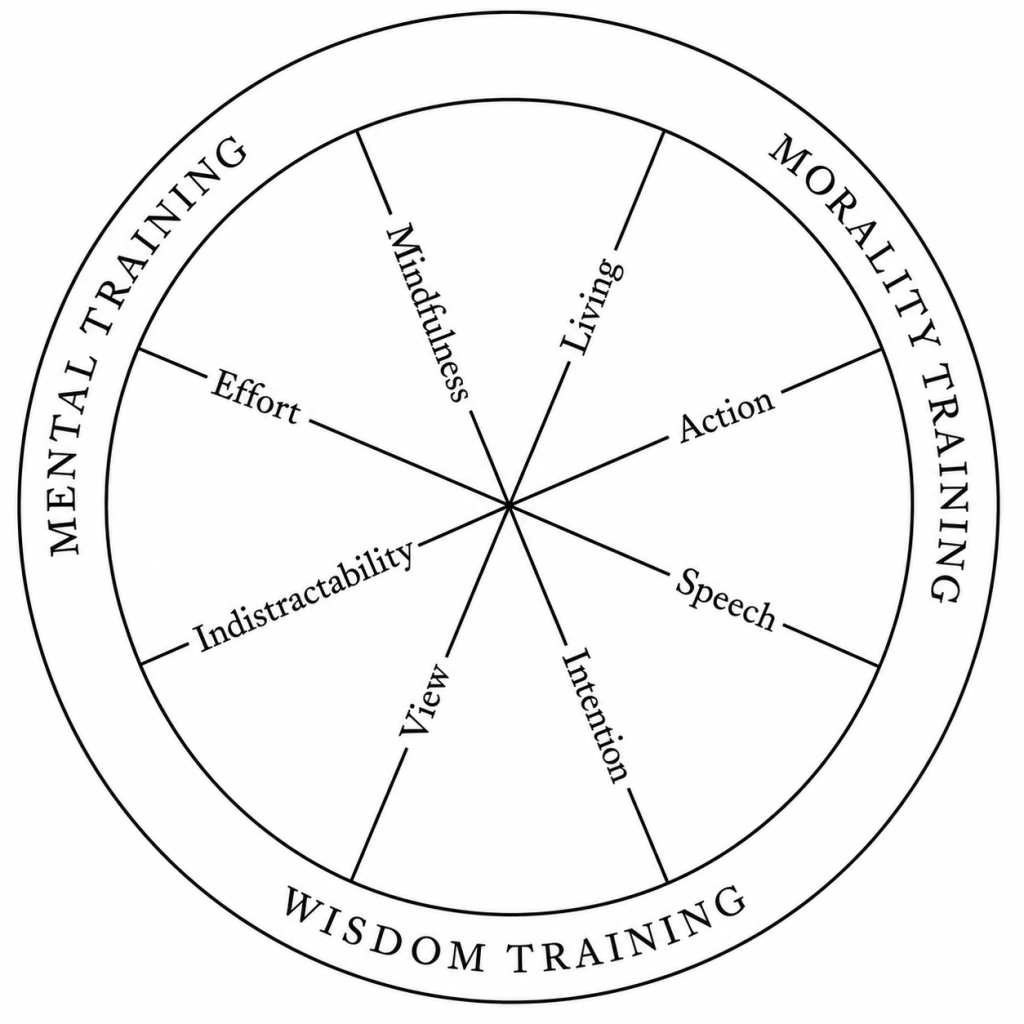
Rather than viewing the eight factors you are about to read about as stages or steps, it is better to think of them as spokes in a wheel. The wheel constitutes the ancient Indian sage’s complete user manual. Buddha’s teachings are known as dharma, and the dharma wheel, as it is called, is perhaps the most widespread Buddhist symbol.
The wheel illustrates, better than the path, that the Buddha’s method is holistic and balanced. There is no point in pouring all your energy into one of the points and ignoring the others. If you read lots of books to gain more wisdom but never meditate – or meditate a lot but aren’t mindful of how you speak to others – you won’t derive proper benefit from the Buddha’s recipe. Some ingredients will still be missing.
The path is best thought of as a wheel to remind us that things are interconnected: understanding influences behaviour, external life influences inner life, mindfulness influences intentions. That is how life works.
*
In the simplified version – that is, the threefold training – the factors are traditionally listed in a different order. There, the sequence goes from morality, through mental training, to wisdom. The wheel is the same; it is simply a different starting point – corresponding to a widespread Zen Buddhist teaching method: when a young person sought admission to a monastery, he or she was set to work sweeping the courtyard. Everyday work was seen as training in ethics and humility. Only when the young person had reached a certain maturity was he or she allowed to learn to meditate. This, in turn, matured him or her further into wisdom.
The American meditation teacher Leigh Brasington (b. 1949) sums up this threefold training in this way: “Clean up your act, concentrate your mind, and use your concentrated mind to investigate reality.” It is a wonderfully simple and contemporary formulation of what the path is all about.
The user manual – the Buddha’s recipe for a better life – can thus be summarised under three headings:
Get your act together.
Calm your nerves.
Find out how things really are.
In practice, as I said, the order in which you do this isn’t that important. For me, it began with an urgent need to calm my nerves. So I started by meditating a great deal. As things gradually calmed down, I gradually realised how my problems were linked to my attempts to solve them. It became increasingly clear to me why ‘work hard, party hard’ wasn’t a viable path, but simply kept me stuck in the rut. Out of the calm of meditation and the clarity of understanding, a healthier way of behaving then grew, quite of its own accord over several years. I got my life back on track. I became kinder to myself and others. I took greater responsibility and made wiser decisions. It became a better life for me.
I see a similar starting point in many of the people I coach. They often come to me to get to grips with stress or other mental distress. So we start with mental training, typically with breathing meditation. But before long, wisdom training comes into the picture, and we begin to talk about the patterns in their self-understanding and their lives that are creating all that stress and unhappiness. This then forms the basis for them to start doing things differently.
The threefold training is a wheel, and once it starts turning, one thing leads to the next and the next.
Relevance of the Buddha
In my view, the Buddha’s teachings are at least as relevant today as they were 2,500 years ago. Fundamentally speaking, being human has not become any less of a struggle. What the Buddha can teach us is how to lead a simpler life, a freer life. The eternal pursuit of stimulation has always been a poor strategy for finding fulfillment. The Buddha exposes this ineffective mechanism and points to a better way. From a Buddhist perspective, we see things more clearly. We see that the burning urge is insatiable, whether it is a craving for sugar or intoxicants, for status or power, for new travel destinations or new things to own. We see that what the craving demands is eternal satisfaction, eternal intoxication, eternal escape. But everything we seek satisfaction in is impermanent, unreliable, transient, and even when we get what we want, it torments us – for the moment we have obtained it, the struggle to preserve it, defend it, hold on to it, prolong it begins.
In short, we struggle with many of the same afflictions as people did in the Buddha’s time, often even in a more intense form or on a larger scale.
Take something like communication. The Buddha’s guidance on how we best communicate with one another is even more important today, given modern communication technology and the challenges it poses for both mental well-being and social cohesion. Buddhist wisdom is highly relevant to our behaviour on social media and our relationship with the internet’s vast abundance of information. So, in the chapters on appropriate view (page 34) and appropriate speech (page 76), we address both misinformation and ‘alternative facts’, as well as online waste sorting and the art of being a Buddha on Facebook.
Growth, GDP and the climate crisis may not be topics you expected to encounter in a book on the Buddha’s teachings, but here a Buddhist perspective is actually highly relevant, as we shall see in the chapter on appropriate living (page 111). Here, the ongoing ecological collapse is explained as an expression of a deeper spiritual crisis or meaning crisis afflicting humanity. It turns out that some of the Buddha’s key points may help steer developments in a more favourable direction.
And that is not all. The mental training that the Buddha advocates – and for which he provides very concrete instructions – can make a decisive contribution to resolving what is known as the attention crisis: We have created a world that is just as destructive to our naturally well-functioning attention as all manner of insidious additives are destructive to our natural hunger. And just as the obesity epidemic is primarily due to the food industry and not to a sudden increase in greed and laziness among the masses, the attention crisis is not due to many of us suddenly becoming absent-minded and thick-headed. It is caused by modern communication technologies, the ever-increasing pace of life, an information overload and a range of other external factors. From this perspective, a daily meditation practice can be seen as a political, indeed perhaps even a revolutionary act: we are reclaiming our attention from those who exploit it, destroy it and turn it into gold. We will return to how you can take up this struggle in concrete terms in the chapter on appropriate mindfulness (page 148).
The Buddhist method must be adapted to your life
When the Wheel of Dharma is put into words, it becomes a path. So in this book, I go through the eight factors in order, in fact as one step at a time. For most people, the straight path is probably the easiest way through the book. But you’re welcome to jump back and forth along the way if your temperament is more like the wheel. You can also start with the chapter you’re most curious about. But make sure you cover all eight spokes. Otherwise, the wheel will wobble.
Buddhism is something you do or practise doing. That is why it is called a Buddhist practice. The Buddha’s method is meant to be used, tested and adapted – in your life. One of the good things about it is that it is self-regulating: you try something from the old recipe, note down what comes of it, make corrections if necessary, and try again. The evaluation criterion is simple: does this give you more breathing space in life? Is it a relief?
There will be ample opportunity to test the recipe as you read through the book, for there is plenty of very practical advice, suggestions for exercises and prompts for reflection. I would really encourage you to pause in your reading, put the book down and try out some of the advice, do some of the exercises, and spend time on some of the reflections. Because no matter how much Buddhist wisdom I might have managed to pack into this book, you won’t get any benefit from the recipe if you don’t bake the cake.
Also, pay attention to what is happening inside you as you read. That can be an exercise in itself, right from start to finish. If there is anything you read that, for example, makes you feel discouraged or irritated, then investigate why. Look within. What do these words do to you? What thoughts and feelings arise? Explore your discouragement or your irritation – be fearless! Because if that is what is stirred within you, you are on the trail of something very important.
Namely, a fundamental fact that is the very starting point of the Buddha’s teachings: There is suffering. Or to put it plainly: Sometimes life is a right pain. That is where the path begins. Right in the thick of it. Where things feel off-key. Where we get stuck.
So before we set off along the path, we need to linger a while in the mess. To understand it, to get to know it. There is suffering: this is the first of the Four Wise Truths, which form the essence of the Buddha’s teachings. We shall look at these in the next chapter, which deals with the ancient Indian sage’s timeless analysis of the problem of suffering and the fundamental conditions of human existence. What is it that causes us to become stuck? And how might we reconnect more deeply with life — so we can more readily enter those moments when everything feels exactly as it should?